In response to recent COVID-19 concerns, we are writing to assure our patients that we are taking and exceeding recommended precautions. Our mission is to keep you and our staff safe.

Close
×

Would you like to switch to the accessible version of this site?

Go to accessible site Close modal window

Don't need the accessible version of this site?

Hide the accessibility button Close modal window
Accessibility View Close toolbar
Menu
  • Home
  • Dental Services
    • Implants
      • Dental Implants
      • Mini Implants
      • Dental Implants FAQ's
      • Iluma Ultra Cone Beam CT Scanner
    • Cosmetic Dentistry
      • High End Cosmetic Case
      • Veneers
      • Whitening
      • Flash Smile
      • Snap On Smile
      • Bonding
      • Inlays and Onlays
    • Restoration
      • Bridges
      • Crowns
      • Dentures
      • Composite
    • Dental Hygiene
    • Pediatric
      • Sealant
      • Mouth Guards
    • Periodontic
      • Biopsy
      • Bone Grafting
      • Canine Exposure
      • Ridge Augmentation
      • Sinus Augmentation
      • Crown Lightening
      • Frenectomy
      • Gum Crafting
      • Occlusal Adjustment
      • Periodontal Splinting
      • Osseous Grafting
      • Cosmetic Periodontal Surgery
      • Periodontal Gum Disease
      • Scaling and Root Planing
      • Soft Tissue Graft
      • Osseous Surgery
    • Oral Surgery
      • Wisdom Teeth
      • Extraction
      • Extraction Site Preservation
      • Oral Pathology
      • Sleep Apnea
    • Orthodontic
      • Invisalign
      • Clear Braces
      • Traditional Braces
      • TMJ
      • Night Guards
  • Why Choose Us?
  • Our Office
    • Location and Parking
  • About Us
    • Meet The Doctors
    • Meet The Staff
  • How To Schedule
    • Schedule Now
    • New Patient Forms
    • Q and A
    • Educational Video
    • Surgical Instruction
      • After Wisdom Tooth Removal
      • Before Anesthesia
      • After Dental Implant Surgery
      • After Impacted Tooth
      • Multiple Tooth Extraction
    • Post Op Instructions
    • Links
  • Our Technology
    • Sedation
      • Anxiolysis
      • Sedation Q & A
      • Sedation F & Q
    • Laser
    • Panorex / TMJ images
    • IntraOral Camera
    • Rotary Indodontics
    • Electric Handpiece
    • Cone Beam 3D
    • Oral Cancer Screening
    • Digital X-Ray
  • Testimonials
  • Contact Us
  • Newsletter
  • Patient Education
    • Educational Videos
    • Cosmetic & General Dentistry
    • Emergency Care
    • Endodontics
    • Implant Dentistry
    • Oral Health
    • Oral Hygiene
    • Oral Surgery
    • Orthodontics
    • Pediatric Dentistry
    • Periodontal Therapy
    • Technology
Round Tooth Logo

Let Us Be Your Dental Home!

Cesar O Cruz, DDS AEGD

(206) 525-6636

8014 35th Ave NE, Seattle WA 98115

Call for appointment or send us a request.

Online Schedule
  • Home >
  • Articles >
  • Tooth Care >
  • X-Rays

X-Rays

  • Created in Tooth Care

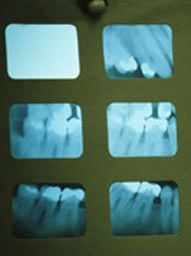
When X-rays pass through your mouth during a dental exam, more X-rays are absorbed by the denser parts (such as teeth and bone) than by soft tissues (such as cheeks and gums) before striking the film. This creates an image on the radiograph. Teeth appear lighter because fewer X-rays penetrate to reach the film. Cavities and gum disease appear darker because of more X-ray penetration. The interpretation of these X-rays allows the dentist to safely and accurately detect hidden abnormalities.

How often dental X-rays (radiographs) should be taken depends on the patient`s individual health needs. It is important to recognize that just as each patient is different from the next, so should the scheduling of X-ray exams be individualized for each patient. Your medical and dental history will be reviewed and your mouth examined before a decision is made to take X-rays of your teeth.

The schedule for needing radiographs at recall visits varies according to your age, risk for disease and signs and symptoms. Recent films may be needed to detect new cavities, or to determine the status of gum disease or for evaluation of growth and development. Children may need X-rays more often than adults. This is because their teeth and jaws are still developing and because their teeth are more likely to be affected by tooth decay than those of adults.

  • Dental Education Library
    • Oral Health Topics
    • Tooth Care
    • Dental Problems
    • Treatment
      • Cosmetic Dentistry
    • Pain Management
    • Patient Information
    • Product Reviews
    • Glossary
    • Links


Find Us on Facebook for Daily Oral Health Tips

Contact Us

Send Us an Email

Our Location

We are in the heart of Wedgwood!

Office hours

(Lunch 1-2 pm)

Monday:

8:00 am-6:00 pm

Tuesday:

8:00 am-6:00 pm

Wednesday:

8:00 am-6:00 pm

Thursday:

8:00 am-6:00 pm

Friday:

Closed

Saturday:

Closed

Sunday:

Closed

  • Copyright © 2026 MH Sub I, LLC dba Officite.
  • Admin Log In
  • Site Map